9 Jan, 2026
 5 mins read

Price action traders rely heavily on candlestick patterns to interpret market behaviour. Among these patterns, the pin bar candlestick stands out for its simplicity and effectiveness. It highlights strong rejection of price levels and often signals potential reversals or continuations when used correctly.
Understanding how this candle forms, what it represents, and how to trade it with proper confirmation can significantly improve decision-making in technical trading.
A pin bar candlestick is a single-candle price pattern characterized by a long wick and a small real body. The long wick shows that the market strongly rejected a particular price level before closing closer to the open.
The pin bar candlestick pattern reflects a shift in control between buyers and sellers within a single trading session. Although price initially moves aggressively in one direction, it reverses sharply before the candle closes.
This rejection makes the pin bar a powerful signal when it appears at important technical levels.
A pin bar indicates price rejection and potential change in short-term market direction. The long wick shows where price was rejected, while the small body highlights indecision or loss of momentum.
When formed near support or resistance, the pattern often signals exhaustion of the prevailing move. In trending markets, pin bars can also act as continuation signals when they align with the broader trend.
However, the candle alone does not guarantee a reversal. Context and confirmation remain essential.
Not every candle with a wick qualifies as a reliable pin bar. A valid pattern typically has the following traits:
The wick should be at least two to three times the size of the real body
The body should be small and positioned near one end of the candle
The long wick must clearly show rejection of a price level
The candle should stand out compared to surrounding price action
Pin bars that appear randomly in the middle of a range carry limited significance. Location matters more than the candle shape itself.
There are two main types of pin bar candlestick patterns, each reflecting different market behaviour.
A bullish pin bar candlestick forms after price rejects lower levels. It has a long lower wick and a small body near the top of the candle. This pattern suggests that buyers absorbed selling pressure and pushed price higher before the close.
Bullish pin bars are most effective when they appear near support zones, demand areas, or key moving averages.
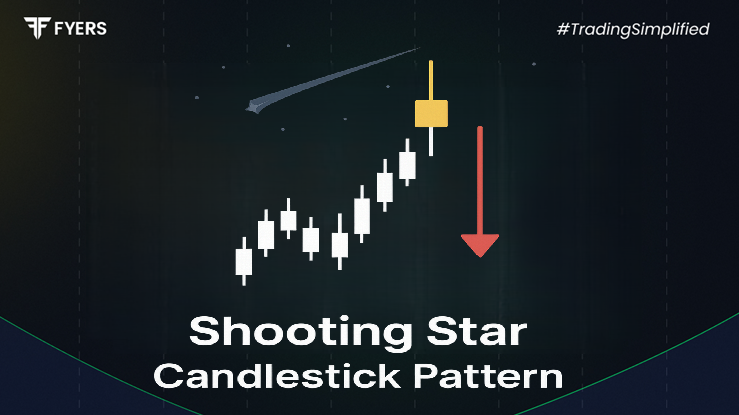
A bearish pin bar candlestick shows rejection of higher prices. It has a long upper wick with the body near the lower end. This formation indicates that sellers regained control after buyers failed to sustain higher levels.
Bearish pin bars work best near resistance zones or during overextended rallies.
A pin bar candlestick pattern strategy should always include confirmation. Traders typically combine pin bars with support and resistance, trend direction, or momentum indicators.
One common approach is to trade pin bars in the direction of the prevailing trend. For example, in an uptrend, traders look for bullish pin bars forming near pullback zones. This increases probability and reduces false signals.
Stop losses are usually placed beyond the wick, while targets are set at nearby resistance or based on risk-reward ratios.
Trading the pin bar candlestick involves a structured process:
Identify the trend or key price level
Wait for a clear pin bar formation at that level
Confirm the setup using volume, trend structure, or indicators
Enter the trade after the candle closes
Place stop loss beyond the wick
Define a realistic profit target
Avoid entering trades before the candle closes. Premature entries increase the risk of false breakouts.
Consider a stock trading in an established uptrend. Price pulls back to a previous support zone and forms a bullish pin bar with a long lower wick. The next candle breaks above the pin bar high, confirming buying strength. This setup provides a low-risk entry aligned with the trend.
In another scenario, an index rallies sharply into resistance and forms a bearish pin bar. The long upper wick shows rejection, and follow-through selling confirms weakness. This creates a potential short-selling opportunity.
These examples highlight why context is crucial when interpreting pin bars.
Pin bars can form on any timeframe, but higher timeframes generally provide more reliable signals. Daily and four-hour charts filter out market noise and reflect stronger institutional participation.
Intraday traders often use 15-minute or 30-minute charts, but these require stricter confirmation due to frequent false signals.
Beginners should start with higher timeframes before applying pin bar trading to shorter intervals.
One common mistake is trading every pin bar without considering market structure. Another is ignoring trend direction and entering counter-trend trades repeatedly.
Traders also place stop losses too close to the wick, leading to premature exits. Overconfidence in the candle pattern alone often results in losses.
Pin bars work best as part of a broader price action framework, not as standalone signals.
The pin bar candlestick is suitable for beginners because of its simple structure and clear visual cues. However, beginners must focus on quality setups rather than frequency.
Learning to identify strong support and resistance levels and practicing patience are essential. When combined with sound risk management, pin bar trading can become a reliable entry technique.
The pin bar candlestick is a powerful price action pattern that highlights rejection and potential shifts in market sentiment. When traded in the right context and with confirmation, it can offer high-probability trade setups.
Understanding its types, characteristics, and strategic use helps traders avoid common pitfalls and improve consistency. Like all technical tools, the pin bar works best when combined with discipline, patience, and proper risk control.
It can be both. A bullish pin bar rejects lower prices, while a bearish pin bar rejects higher prices.
Its reliability depends on location, trend context, and confirmation. On higher timeframes, it is generally more dependable.
Yes, but intraday pin bars require stronger confirmation due to market noise.
Support and resistance, moving averages, volume, and trend indicators work well with pin bar setups.


Calculate your Net P&L after deducting all the charges like Tax, Brokerage, etc.

Find your required margin.

Calculate the average price you paid for a stock and determine your total cost.

Estimate your investment growth. Calculate potential returns on one-time investments.

Forecast your investment returns. Understand potential growth with regular contributions.
Candlestick charts are one of the most widely used tools…
30 Sep, 2025
4 mins read

You have successfully submitted your partnership request form. You will be hearing us soon!






 Back
Back