In this consultation paper on algo trading published yesterday, SEBI sought views from intermediaries and all stakeholders about the discussion points highlighted by them.** The working group at SEBI has proposed the following framework for retail algo trading**:
All algos need to be approved by the exchange and identified by unique Algo IDs.
Each algo should be certified by a CISA/DISA auditor.
All algos should run on the brokers’ servers.
API level RMS checks to be ensured by brokers to prevent misfiring trades.
A broker can offer in-house strategies or will have to enter into agreements with third parties.
Stockbrokers must assess the suitability for investors before offering algo facilities.
2FA should be built into the system.
Software used to create algo strategies should be approved by the exchange.
Brokers should submit details of checks & balances for algos during annual system audit reports as per the format provided by the exchanges
More clarity is required on the nature of services rendered by third party algo service providers. Currently, there is a very limited understanding about whether they are research analysts offering strategies or creating strategies based on traders’ requirements etc.
My thoughts:
SEBI’s concerns are very legitimate because, in the history of capital markets, unqualified persons rendering advice have led to a lot of avoidable losses for retail investors. To streamline the advisory business and to prevent irresponsible advisory practices, they introduced the Registered Investment Advisors (RIA) concept to make sure only certified persons/entities can advise their clients. However, due to the stringent compliance requirements, many have chosen to remain unregistered and operate outside the regulatory framework. It would be great if the compliance & other requirements are eased a bit to encourage people to take this path.
Traditional tipsters who used to give buy/sell calls offline are now masquerading as algo experts. Overfitted & skewed backtested results lure retail investors to believe that it will happen in reality (It might happen for a while but then it’s not as easy as it is made to seem). As a matter of fact, these back-tested results are not audited, certified and thus, is an area of concern. In the past, tipsters from Indore and other places were notorious in promising unbeatable returns and obviously under-delivering. The regulator wants to be sure that this ecosystem develops in the right manner.
Algo trading is the natural evolution of trading manually. Retail traders do not trade full-time because they work at jobs/businesses and participate in the markets to earn additional income or to grow their capital. For many, tracking the markets manually and waiting for prices to arrive before they can trade can use up a lot of their valuable time & energy which they much rather devote to their jobs which requires their presence of mind. Hindering traders’ ability to participate objectively can be a regressive move.
Algo trading helps retail traders approach the markets objectively as it eliminates emotions from the decision-making process. The benefits of this approach are multi-fold. The vast majority of the losses incurred by retail traders are because of emotional impulses. Access to algo trading helps avoid blunderous trading mistakes. The results of their trading strategy can be analyzed and optimized. The capital deployment is well thought out as compared to discretionary trading. Traders will last longer in the markets to learn, deploy new strategies, and evolve with the marketplace. Although it is debatable, it can increase the odds of long-term survival. All this is positive for the capital markets. Over-regulation can kill this vibrant space in its infancy. I’m sure SEBI is concerned about the effects that tipsters will have and the too-good-to-be-true pseudo-fund managers.
In general, algo traders are suspicious of getting their strategies tested & approved by the exchanges because they believe their strategies will get exposed and will be ultimately used by some secretive HFT/murky operators. It is natural to feel this way but the exchange essentially looks at the risk management elements of the trading strategy. They’re not concerned about the potential profitability of your trading strategy. You’ll have to be less worried about the exchange and in this case, be more worried about the broker! Why? The answer is simple - Proprietary trading. As I have said before, brokers’ prop desks can be notorious, and are constantly looking for new trading ideas from wherever they can find them. What better than a profitable algo trading client who has to expose the blueprint to his success because of regulations? One way you can avoid this conflict of interest is by choosing a broker that doesn’t do any prop trading. FYERS is among the only few brokerages that don’t have a prop desk so there’s no risk of your strategy being misused.
Apart from that, it’s impractical to get all strategies approved at a client level, and here’s why:
Exchange test environment (mock sessions) happens once a month only.
At times, testing may require more than is available during mock sessions.
Trading strategies change all the time. Getting every change approved is a nightmare scenario.
It is burdensome for the exchange/s & brokerages to deal with the growing number of approval requests for any changes made to the trading strategies.
It’ll increase the costs for retail traders due to services rendered by brokers & CISA/DISA auditors.
If the broker’s systems go down, there will be no way that the retail clients can manage their risks. Currently, they can switch off their strategy if there is any problem with the broker’s API because it is hosted by the clients or some third-party platform.
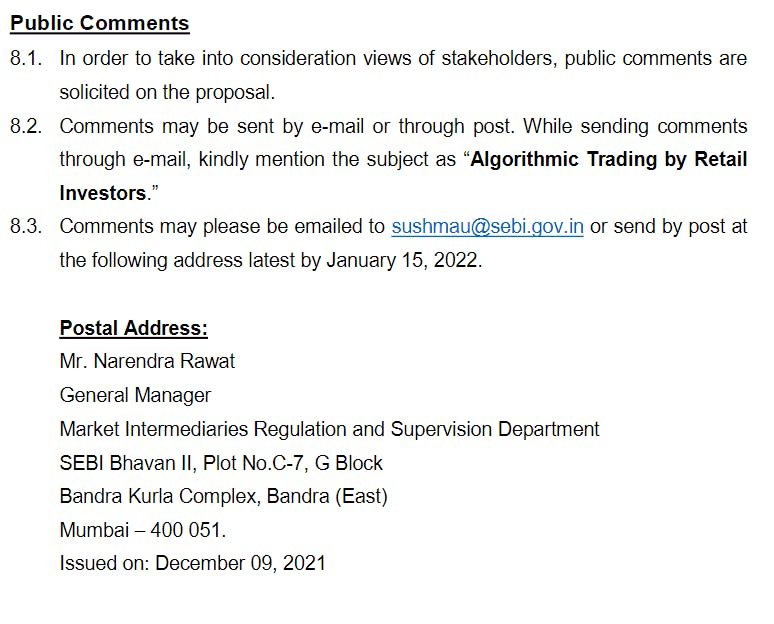
We hope the regulator takes a constructive stance w.r.t retail algo trading and sees the long-term benefits of systematic trading. It can create a level playing field for retail investors as compared to prop desks, deepen our financial markets, promote rational risk-taking among all participants, potentially increase the survival rate of traders, and overall increase the market participation nobody has the time to track markets all day; it would reduce their productivity at their workplace. Let’s see what happens next. This is all we know for now. We encourage you to write your comments & send your constructive feedback to the following address:
**P.S **- We understand that many retail traders are vocal critics of SEBI for the peak margin implementation and other recent regulations but please understand that they’re doing all this to safeguard your interests. The intent cannot be overlooked. If you wish to send your feedback, kindly write your points objectively and request them to look at it from your point of view. No point in being rude or aggressive! 10 years later when we look back, I’m sure we’ll feel lucky to have had a vigilant regular like SEBI.
This consultation paper seems to be supporting algo trading platforms by regulating them and in turn wiping out unregulated/unapproved sale of algos by platforms.
Have created a code snippet only for sending orders thru API for minimizing slippage (Profits increased by 70% compared to manual entry). How is this algo trade?
Another snippet for SIP investing first Monday of every month if the price of one of top 3 NIFTY 50 stocks goes down by 5% from Open price that day. We are not sending 100 orders every minute, we just retailers who need a reasonable max order limit for the day for our benefit of our hard earned money to build a portfolio. We are neither gullible to be victims for MF industry or these Algo sellers.
One other API based code that presents user trade reports in a very insightful with visual representation. SEBI is destroying all these innovations.
If Algo sellers want a growing business, they will compile if asked to get certified (RI/RIA/maybe AA/whatever), their algos approved by exchange with ids allotted, audit done for ROI claimed and then allowed to sell their products. All SEBI needs is to issue this requirement and advice investors to opt for certified advisors, if they want which their grievances, if any, to be addressed.
All retail API orders have the same RMS checks as manual orders. Where is the risk to market? Did SEBI analyze freak trades and recent crashes to conclude it was API orders or institutional ones that caused these outages?
Some brokers who provide API, permit"access token" combined with sms/email 4 digit OTP “access code”, both of which with validity for 24 hours only. This way 3rd party Algo sellers cannot simulate clients account using API easily. Along with max order limit, certification, OTP … API usage will be streamlined for exactly what is it meant for: create a disciplined investment, allow fintech innovations, enable larger, safer participation and mostly importantly accommodate newer legitimate entities.
To reach this point of explaining the absurdity of equating API access with Algo trading is the direct result of appointing coaching class outputs cadres to niche positions after feeding them with ego for three years at training center at Dehradun. Products servile to their superiors and dictatorial to all others, exactly as British wanted their native administrators to be.
Reading through other media reports concerning this particular matter, the unregulated advisory situation given as an example might not be the real reason why these reforms are being pushed for
Firstly, We don’t have a clear understanding on, who are these group of people wanting to see such regulations implemented. This lobbying for reforms doesn’t seem to be coming from the active retail trading community , the algo service providers, the broker community or the SEBI, so who are the group of people behind this?
What is visible though the other media reports are that the lobbying for these reforms seems to be coming from a group of uncles and aunties ( the retired folks who found a new purpose with life as investor activists post retirement age and set out to making lives difficult for the younger generations ) who themselves doesn’t seem to have any qualifications or the technological competence to understand what algo trading does and is about.
The people who wants to see these reforms implemented seem to be fearing only one thing, somehow they are strongly misguided through a bigger force at play, that algo trading can influence the natural flow of demand on supply on a larger scale which might then indirectly affect their own retirement interest in the capital markets and of the other investors.( which seems to be irrational considering the appropriate measures already in place by the exchanges )
Allow API for retail users for disciplined trading
Concerns:
How to differentiate illegal trading from permitted ones (in API orders)
**Algo ecosystem entities: **
Algo sellers
Algo platform providers (a place for sellers and retailers to interact)
Algo platform providers to assist retailers to automate trading (software run on providers’ servers)
Algo platform providers to assist retailers to automate trading (software run on clients’ machine)
What is needed from the Regulator?
For Entity 1 create a new certification and process (AA or AIA much like RI, RIA). For immediate purposes, RI/RIA should be made mandatory. Should demonstrate to Exchanges the risk metrics of their system in audit and can tie up with brokers. Each AA is given an AA id and Algo id. Auditing verifies ROI claims.
For Entity 2 create a new Certification (Algo Infrastructure) which should mandate only RI/RIA/AA/AIA can advertise on their platforms. The need to link up with brokers too. These platforms are merely a layer over brokers’ oms. Say, a client subscribes AlgoExample1 from an AA vendor, the platform sends it to the preferred broker(as configured by the client AND as supported by the broker). Broker reads the AlgoID, subscribes the client and issues an order as per AlgoExample1. Through the platform, a client can subscribe to any Algo from any broker and have a centralized view of his/her positions.
Auditing is mandatory for these platforms where they need to present records from AAs that certify the trades done on each Algo ID.
Entity 3 and 4 are software providers.
What is needed from the Broker?
Brokers to Allow API orders that have Algo IDs of only those who have tieup with them
(Brokers can be very selective in choosing their AAs), this deal has to be approved by the exchange.
Brokers to Allow API order (without Algos IDs or unrecognized Algo IDs) with several restrictions. The max order limit per minute, per day, modification order limit will be very severe. (Limits to be specified by the exchange). Also, Brokers can introduce a speed bump delay (range to specified by exchange, typically 1 second to 30 seconds) for new orders and modification orders. Also, only limit orders permitted for 1st leg. Squareoff and cancel orders thru API dont face any delay.
The above system allows for:
Algo players to legitimately be in the industry and grow.
Retail investors can independently make use of APIs for their limited trading and investment need by automating.
Brokers to grow their business with tieups with well performing Algos from Sellers
Algo providers can give a marketplace for certified Algo sellers and buyers. Please note that Algo sellers can execute their order only through Broker servers, which whom they have tie-ups.
Retail investors can avail the services of Automated software for executing orders from their own systems OR Automated platform server. These API order have several restrictions such that render them as mere automation enablers and not algo trading software.
Other notes:
Algos are intellectual property. Exchanges can specify Risk metrics to evaluate them. Algos cannot be revealed even to Brokers (esp with prop desk) or Exchanges/Regulators.
Any responsibility on Algos risk is ultimately borne by Broker only. Therefore, as SEBI proposal suggests these Algos can be run on broker servers. Any changes in Algos need logs, mock trading results, approval from Exchanges.
It is good to see that the regulatory body has taken a step forward towards the protection of retail traders but there is something I am afraid that may be for coming generations a new rule can be brought wherein we have to give an application to the regulatory body about what trade we will be taking after a week and how much quantity. That will certainly give time for regulatory body to make an inquiry into that particular stock so that a retailer’s hard earned money can be saved.
As far as the concern is for regulation, I would say if the regulatory body puts in tighter norms of circuit levels for price then the probability of moving of price will not happen easily, yes but the black sheep has to be put under check who is creating panic by punching huge orders thereby moving prices. So take responsibility in the form of investigating the culprits who were behind the freak trades and take action on them by at least warning them and also have stringent guidelines against the bearer of accounts from where huge canceled orders are emanating so that they do not wag their tail.
Also, strategy is an intellectual property and if it is an individual retail traders’ wish then they can opt out from the regulation. Yes, a platform can be provided to individual retail traders to get the strategy verified/regulated which they have purchased from a vendor so that the retail traders are not taken for a ride. Most important here is that all the order punching structure in the institutional algo has to be regulated by exchange so that the rogue algos can not be rigging of price under the disguise of huge business.
Certainly, to save a person dangling in the middle of a cliff, one can pull him with a rope on their waist/chest and not by the neck, so it is important to check whether the rope is tightened to the neck. If you have irresponsible people at responsible positions then it will do more harm than good, ultimately harming the community for whose protection the body is formed itself.
Looking ahead for a sensible resolution of the issue for the problem that can be caused by algo and reducing the panic in retail trader