The last two trading sessions have resulted in quite a bit of outrage among traders following the introduction of SEBI’s new Closing Auction Session (CAS) starting 3rd August 2026. If you’re new to this, read this post.
On Monday, the Nifty appeared to jump sharply into the close, creating a large difference between where the market was trading at 3:15 PM and the eventual official closing value. On Tuesday, we saw another unusual closing move, along with a noticeable divergence between the Nifty and Sensex. This can look bizarre and it’s natural to ask, what actually happened and is this something we should expect going forward?
A Quick Recap
Until now, the closing price of stocks was determined using the VWAP of trades executed during the final 30 minutes of the Continuous Trading Session (CTS). Under CAS, the process has changed fundamentally. For eligible F&O stocks, continuous equity trading ends at 3:15 PM. Orders then enter a closing auction, where buy and sell interest is aggregated and an “equilibrium price” is discovered. This price becomes the official closing price and not the previous VWAP formula. Effectively, the trades during this session determines the closing price.
Why Did the First Two Days Look So Strange?
I think it’s too early to confidently attribute the moves to any one factor. One possibility is that market participants including brokers, prop trading firms, and institutional desks were still adapting their systems. Vague, right? Yeah but at this point its best not to make any uninformed conclusions about this. But cash market continuous trading ends at 3:15 PM, CAS runs until 3:35 PM, while equity derivatives continue until 3:40 PM. This creates a completely new set of interactions between cash positions, derivatives, hedges and risk management. If participants have positions that need to be adjusted around this transition, those flows can become concentrated around the auction.
Another factor is liquidity. An auction works extremely well when there is sufficient two-way demand and supply. But if liquidity is shallow and there is a significant imbalance between buyers and sellers, the equilibrium price can move sharply. In the last few years, the volume in CAS have been trending up. This article by NYSE is worth reading regarding this topic.
But this isn’t unique to India. Closing auctions are used in major markets around the world, including the US, UK, Germany, Hong Kong and many others. Sometimes, they can produce significant differences between the last continuous-market price and the official closing price. This is particularly when there is a large order imbalance, index rebalancing, or expiry related activity.Hong Kong is a great example. HKEX introduced a Closing Auction Session in 2008 (What a year to do it!). They eventually suspended it in 2009 because of concerns around unusual price volatility and potential abuse. However, after several years, they reintroduced CAS in 2016, the mechanism included stronger safeguards, including price controls and a random closing process. Here’s their latest paper on HKEX CAS mechanism works.
CAS is Perhaps Better than CTS, But Not Bullet Proof
Under the old system, someone trying to influence the closing price could potentially concentrate trades in the final part of the VWAP calculation. This is not an established fact, but a possibility. In an auction, the price is determined by the interaction of a much broader set of buy and sell orders. To move the equilibrium price, you need to create a meaningful imbalance in the auction book rather than simply execute a few trades at the end of the continuous session. That can make manipulation harder when the auction has deep liquidity. The average traded volume (ADV) of stocks in the US has been rising for over a decade. Why not just trade in the CTS? Because generally speaking, large institutional orders can move the price of stocks because liquidity is dispersed over larger period of time. Therefore, they need to split their orders and execute throughout the day using execution algos. We do this everyday for our institutional customers too.
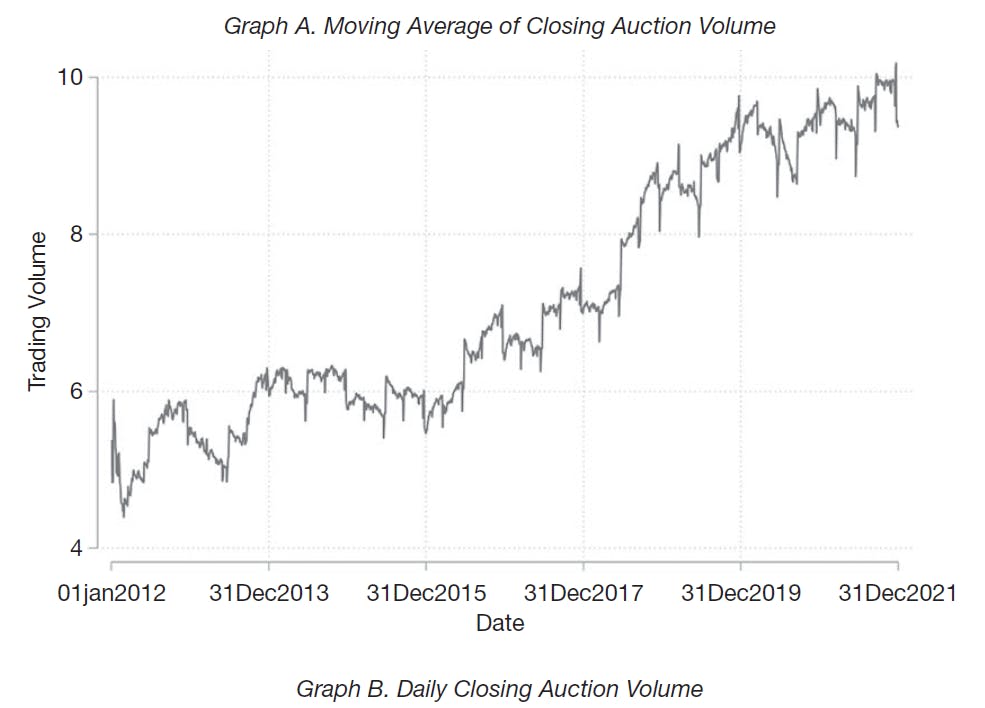
Closing Auction Volume Trend on NYSE & NASDAQ. Source: Camridge Research
Why Did Nifty and Sensex Behave So Differently?
Many traders naturally assume that “If Nifty and Sensex are both supposed to represent the Indian market, shouldn’t their closing moves be broadly similar?” Usually, yes but at the end of the day, they are not the same indices. They have different constituents, simply put, NIFTY has 50 stocks and SENSEX only has 30.
Since CAS is being implemented in the equity cash market at the individual stock level. The closing values of the indices are then affected by the closing prices of their constituents. So if the auction produces unusual closing-price changes across a subset of heavily weighted Nifty constituents, the effect on Nifty can be different from the effect on Sensex.
What About Expiry Days
When a large number of derivative positions have exposure to the underlying closing price, the incentives around that auction can potentially become much stronger. Now, this is the real conundrum, in my opinion. Will these unusual moves continue? It’s hard to tell expecially considering F&O vested interest. But I hope that the frequency and magnitude of these dislocations should reduce as the market adapts, but I wouldn’t expect them to disappear entirely. The first few sessions of a new market mechanism are likely going to be different because brokers need to change risk policies, algos need to be tweaked to adjust to this new system and institutional investors adapting to new ways to execute their orders more effectively. Also, arbitrage traders need to figure out the relationship between the cash auction price and derivatives market.
Managing Trading Risk
So, considering this change, it would be prudent to manage trading risk more conservatively, especially if you have open F&O positions before the market closes and perhaps re-initiate in the next session. Another way is to reduce the position size to limit the absolute MTM impact on your P&L or layer your entry and exits. If you’re an equities trader, you can participate in the auctions too. These are just suggestions and not advice. It’s time to wait & watch how things evolve from here.
It’s an intriguing topic and there’s little information about this this as compared to regular trading articles. But, if you really want to dig deeper into the impact of closing auctions, and continous trading session on the closing price of stocks, I’d recommend you read the attached research paper by Cambridge University.
Happy Trading!


