You have probably had this happen: you spot an opportunity, tap Buy, and by the time the order goes through, the price has already moved. You got filled at a slightly more expensive level than you intended.
This is called slippage, and it is often caused by latency. Latency is the time it takes for your order to travel from your screen, through your broker’s systems, and finally reach the exchange. The longer that journey takes, the higher the chance that the price moves before your order arrives.
At FYERS, reducing the latency on our end is something we take seriously. In this post, we will explain what we have built, how we measure it, and what it means for your trades.
https://www.youtube.com/watch?v=GBNhSr6eMIQ

What happens when you place an order
Your order does not go directly from your phone to the exchange. It makes a journey through a few steps, and each step takes time.
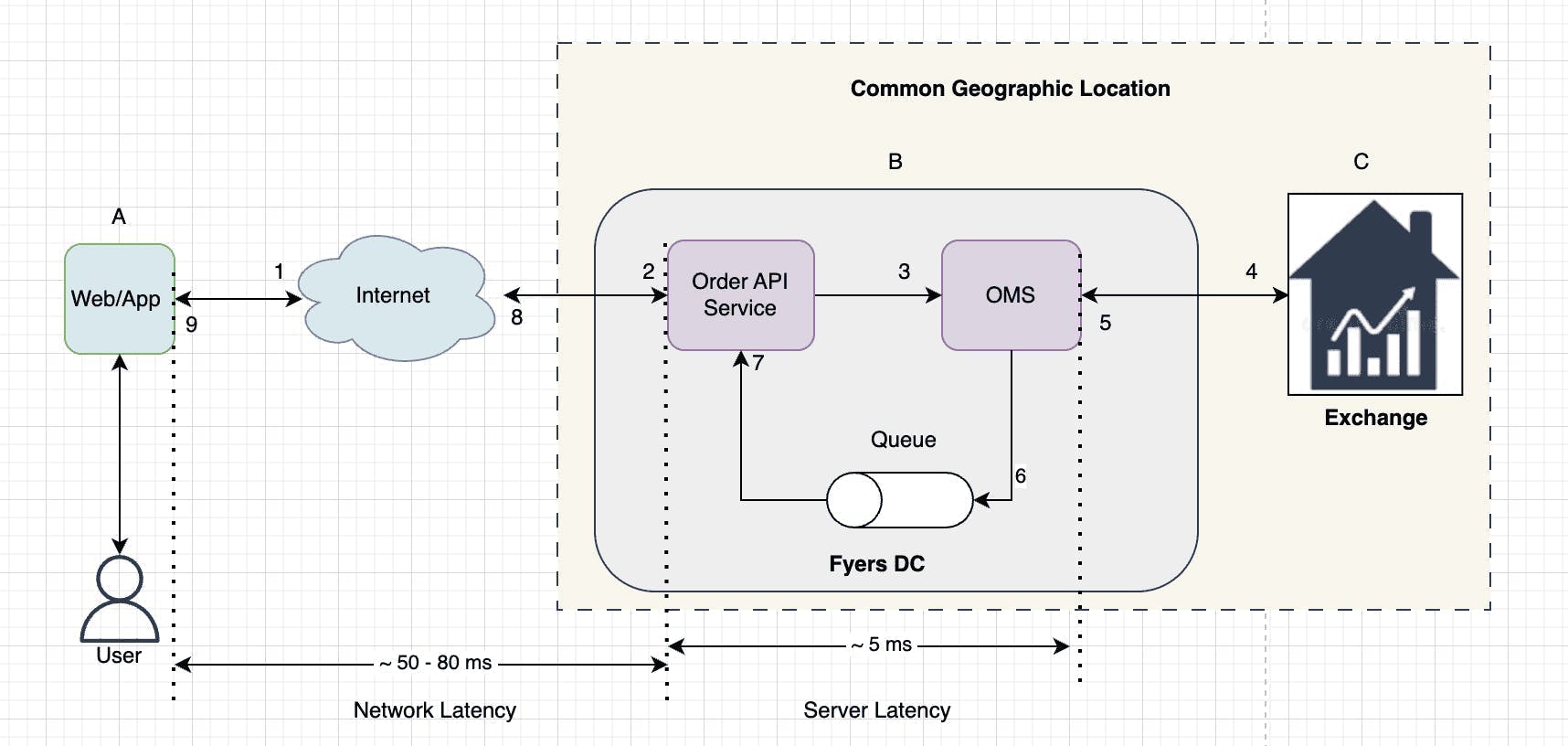
How your order travels from your screen to the exchange
- **You tap Buy **on the FYERS Web or App.
- **Your order travels to FYERS over the internet. **This part of the journey depends on your network connection and typically takes 50 to 80 milliseconds.
- **Your order arrives at FYERS. **Our systems check your margins, validate the order details, and prepare it for the exchange. This is the part we engineer and optimise.
- **The order reaches the exchange **and execution happens. Our servers are located close to the exchange, so this step is extremely fast.
The most important number: Steps 3 and 4, which cover everything FYERS handles on our end, complete in under 7 milliseconds. This is what we control, and what we get independently audited every year.
How we measure our speed
We do not just track the average speed of our system. Averages can look good on a normal day but hide how the system behaves when it is under pressure, such as at 9:15 AM when the market opens, on expiry days, or during major news events. Those are precisely the moments that matter most to traders.
Most performance benchmarks you will see use p90 or p95. We measure at p99 because we think it is the more honest standard. Here is a simple way to understand what that means:
Imagine 100 FYERS traders all placing orders at the same moment. The p99 figure is the time within which 99 out of those 100 orders were processed. Only 1 in 100 took any longer. A low p99 means the system is consistently fast, not just on average, but even during the busiest moments.
This is the standard we hold ourselves to internally, and it is what an independent auditing firm used when they tested our systems.
Order processing speed on FYERS
FYERS processes orders in two ways depending on where you are trading. Here is what the speed looks like for each.
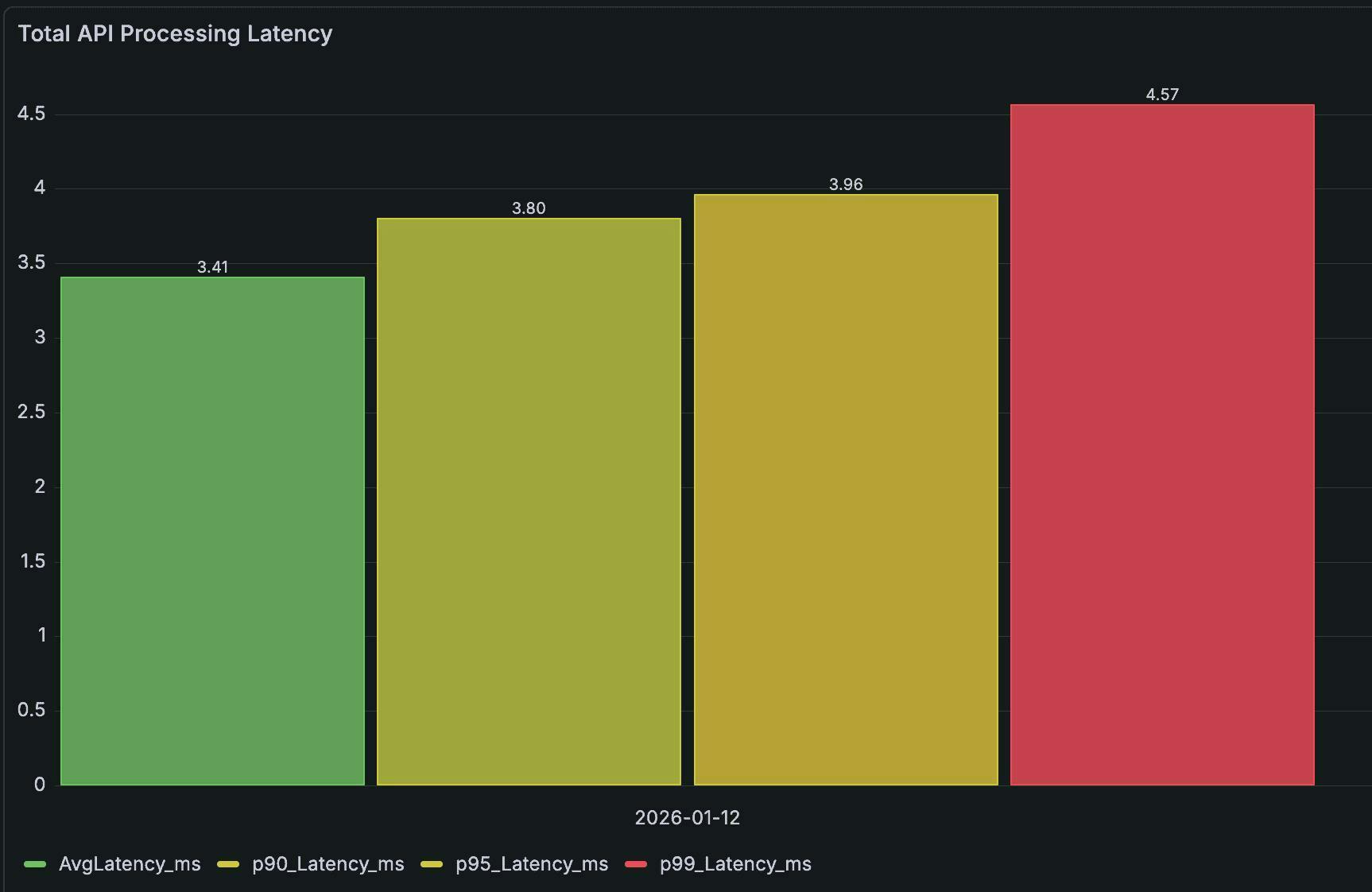
On the FYERS Web and App
When you trade on the app or web, FYERS sends you a confirmation the moment your order is received. Your screen updates instantly. The checks on our end happen in the background at the same time, so you are never kept waiting.
INTERNAL MEASUREMENT - Measured from our own live production systems on a continuous basis.
**4 to 5ms **at p99 (99 out of 100 confirmations arrive within this time)
For reference, a blink of an eye takes 100 to 400 milliseconds. Your order confirmation arrives before you have even registered that you tapped.
For Traders Using the FYERS API
If you place orders through the FYERS API, typically for automated or algo strategies, the flow works a little differently. All checks are completed fully before you receive an Order ID. You get a confirmation only once everything has been validated.
This takes a fraction of a second longer, but it is done this way for a good reason. When a trading strategy is automated, receiving an early confirmation before all checks are done can trigger a chain of unintended actions. Algo traders need certainty before their next step fires.
5 to 7ms at p99
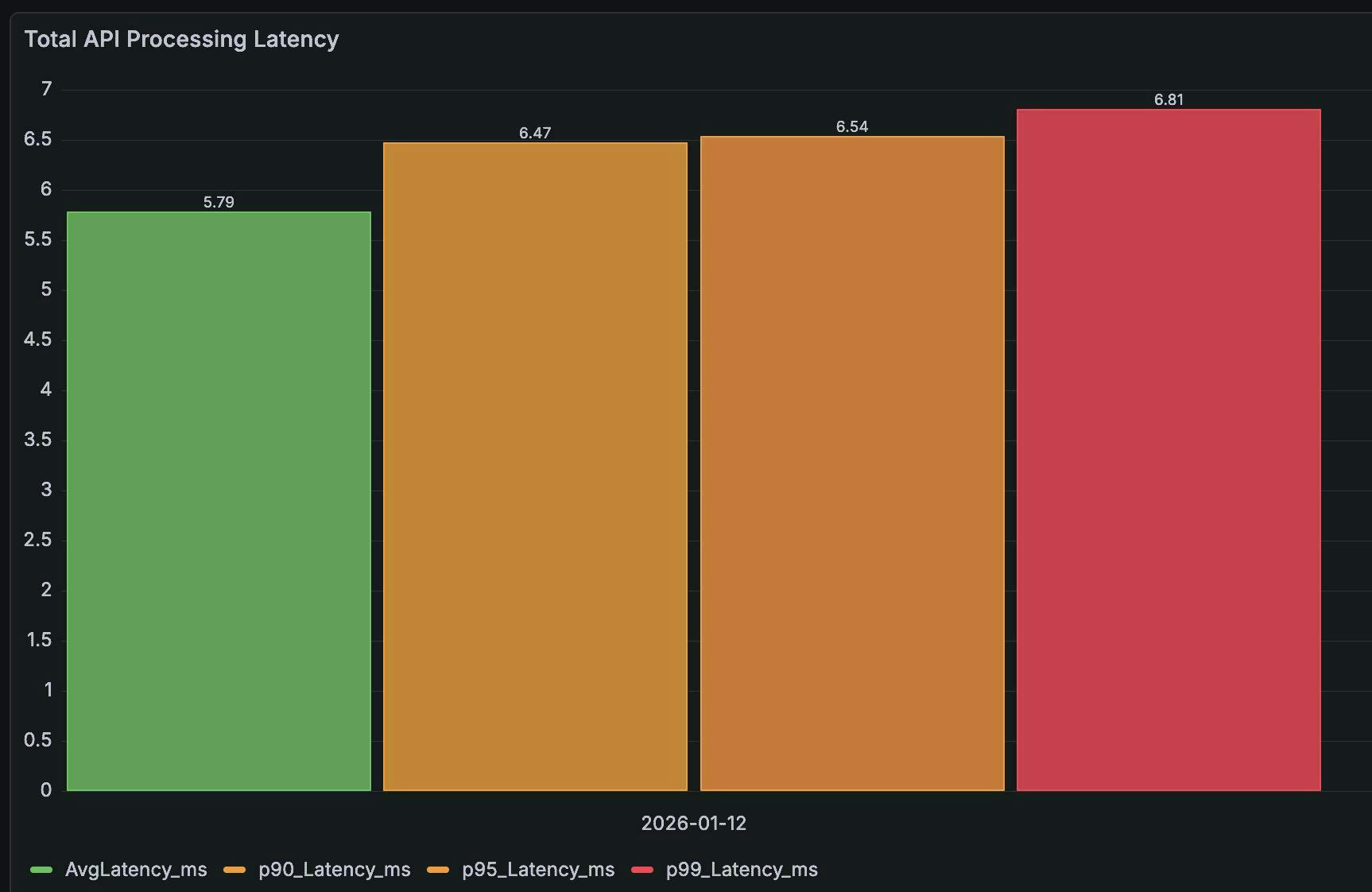
Even at p99, which covers the slowest 1% of moments across all of December 2025, the system stayed within this range.
What the independent audit found
In December 2025, we commissioned, an independent auditing firm with CISA certification, to benchmark our order processing. They tested against real customer orders placed on FYERS across the full month.
Results
-
The auditors also simulated an extreme load scenario to see how our systems hold up under pressure well beyond normal trading volumes.
-
**Load tested: **50,000 traders placing orders at the same time over 30 minutes - **Average processing time: **1.2 milliseconds - **95 out of 100 orders: **under 7 milliseconds - **99 out of 100 orders: **under 13 milliseconds
You can read the full audit report [u]here[/u].
What this means in actual rupees
Here is a concrete example of how order latency translates into trading outcomes.
You are trading a Nifty 50 options contract. The premium on your screen is ₹150.
- On a platform with high latency (50 to 100ms processing time): By the time your order reaches the exchange, the premium may have moved to ₹150.30. You are down 30 paise per unit before the trade has even started.
- **On a faster platform: **Your order may reach the exchange while the premium is still ₹150 or ₹150.05. The difference is 5 paise at most, not 30.
That 25-paise difference adds up quickly. A trader placing 10 orders of 10 lots a day on Nifty 50 saves ₹1,625 every trading day, which works out to roughly ₹32,500 a month. That is money that stays in your account because your orders got through faster.
Understanding the total time an order takes
When we talk about order latency, it helps to understand what contributes to the total time from when you tap Buy to when your order reaches the exchange.
- **Network travel time (50 to 80ms): **The time your order takes to travel from your device to our servers and back. This varies based on your network connection and geographical location.
- **FYERS processing time (under 7ms): **Everything our systems do once your order arrives with us. This includes checks, validation, and routing to the exchange.
So out of a typical total time of around 65ms, under 7ms is the part FYERS handles. The rest is network travel. We share this breakdown not to deflect responsibility, but because it gives you a clearer picture of where speed improvements are possible and where they are not. Our focus is on continuously reducing the 7ms that is ours to own.
What we are working on next
Improving order latency is an ongoing effort. We monitor our systems every day and we bring in independent auditors every year to keep ourselves accountable.
We are currently working on improvements to how orders are routed and on infrastructure upgrades that will bring our servers even closer to exchange systems. The goal is consistently fast execution not just on quiet afternoons, but on the days that put every platform under pressure: Budget announcements, RBI decisions, and weekly expiries.
When you see a price you want to trade at, FYERS should never be the reason you did not get it. That is the standard we hold ourselves to.