


Markets move fast. But before a strategy faces live market conditions, it should answer one simple question.
How would this have worked in the past?
Many traders build a strategy and take it live without testing it first. Sometimes, it is because backtesting feels complicated. At other times, it is because the process sits outside the platform where the strategy is built.
Even if you want to backtest your strategy, it often means using a separate platform, writing code, or spending time setting up third-party tools before you can begin.
As we spoke to traders using FYERS Automate, we heard this challenge time and again. It became clear that backtesting should not be a separate step outside the strategy-building process.
That is why we introduced Backtest in FYERS Automate.
The feature is currently available in Beta. If you would like to get access, let us know in the comments below.
FYERS Automate is our no-code automation platform that lets you build, execute, and manage trading strategies without writing code. You can click here to know more about Automate.
With Backtest, you can now build your strategy, test it on historical market data, review the results, make changes, and take it live from the same experience on FYERS Web and the FYERS App.
One of the biggest challenges in automation is not just creating a strategy. It is trusting it enough to use it in live markets.
Earlier, traders who wanted to validate their ideas often had to move away from their workflow. Some used spreadsheets. Some used third-party tools. Others needed coding or technical setup.
We wanted to bridge that gap.
Backtest brings strategy validation directly into Automate. You can build your logic, test it against historical market data, review how it worked, and improve it before taking it live.
This makes Automate a more complete journey:
Build → Test → Deploy → Monitor → Improve
Backtest does not tell you what will happen in the future. Markets change, and past performance can never guarantee future results. But it can show you how your strategy would have worked in the past, and that context helps you make more informed decisions before putting real capital at risk.
Once you have built a strategy in Automate, you can backtest it in just a few clicks.
Choose the time period, enter the initial capital, add the slippage value, and start the backtest.
You will get a detailed report that goes beyond overall profit and loss. Instead of focusing only on whether the strategy made money, you can understand:
How consistent the strategy was
How often it generated trades
How much risk it carried
How deep the drawdowns were
How charges and slippage affected the final result
You can also switch between Gross View and Net View to compare performance before and after brokerage, taxes, and other charges. This gives you a more realistic picture of your strategy.
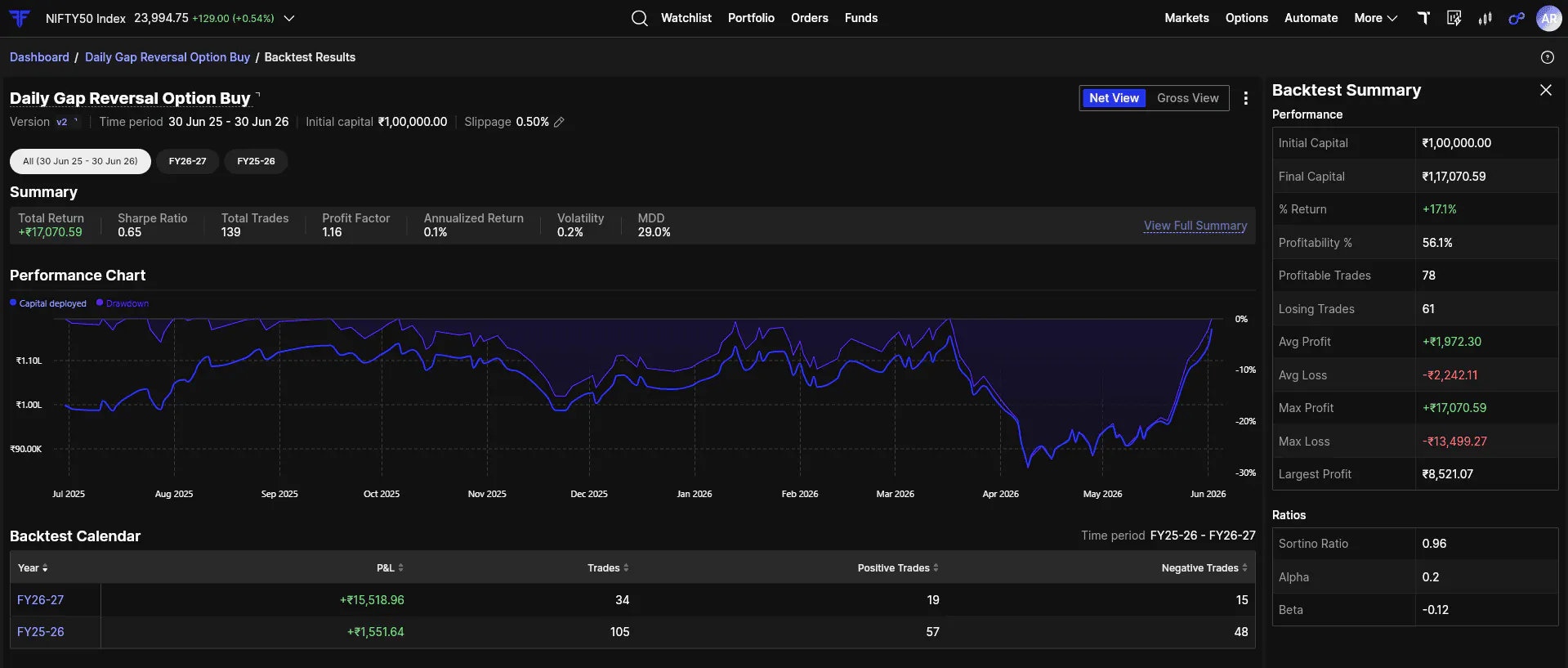
For a detailed breakdown of the backtest summary metrics, refer to this article.
The goal is simple. Backtest helps you understand whether your strategy is worth improving, where it may need changes, and whether it is ready to be taken live.
For example, let us say you have built a Daily Gap Reversal Option Buy strategy.
This strategy looks for a possible reversal when the market opens with a gap. If the market opens higher than the previous day’s close, it buys a put option. If it opens lower, it buys a call option. The trade exits either when the predefined profit or loss target is reached, or at 3:25 PM, whichever comes first.
Here is what the strategy workflow looks like inside the Automate canvas.
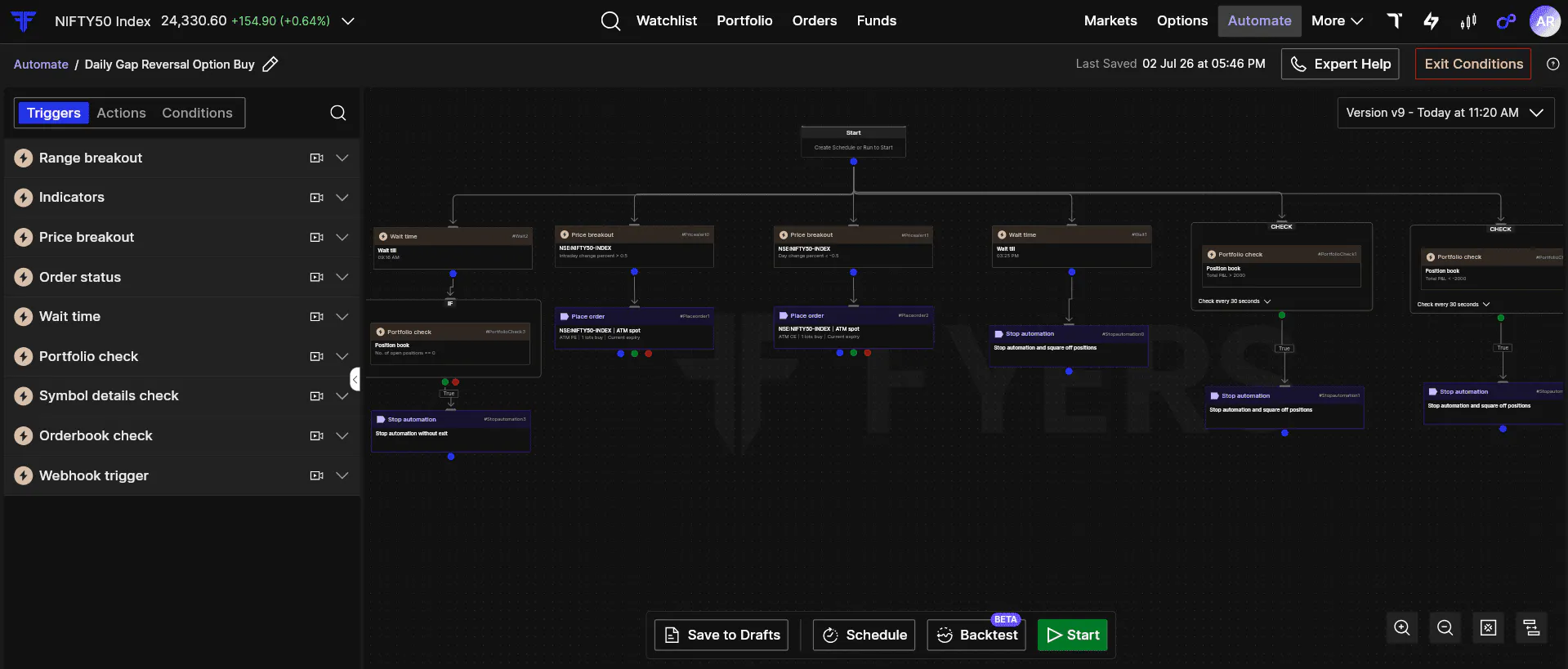
Before running it in live markets, you decide to backtest the strategy over the last 12 months. You set your initial capital to ₹1,50,000 and configure slippage at 0.5%.
The backtest shows a net return of around ₹17,000 (11.4%). The maximum drawdown is 19.4% over the selected period. Along with these, you can also review several other performance metrics such as win rate, trade count, profit factor, Sharpe ratio, the equity curve, and detailed trade history to get a complete picture of your strategy's performance.
These numbers are not just results on a screen. They help you understand how the strategy handled different market days, what kind of risk it carried, and whether the outcome matches your trading style.
If needed, you can adjust the strategy, run another backtest, and compare the results before deploying it in live markets. That means you can test your ideas, learn from the results, and refine your strategy, all without risking a single rupee.
Backtesting is not about finding the perfect strategy.
It is about building a better feedback loop and giving you confidence.
You build a strategy, test it, review the results, improve the logic, and test again. Once it is live, you can continue monitoring how it performs and keep improving it over time.
Backtest is now available in Automate on both FYERS Web and the FYERS App.
The feature is currently available at no cost. If you need help getting started, check out our Backtest FAQs for detailed guides and answers to common questions.
The market will always test your strategy. Backtest helps you test it first, learn from the results, and keep improving with every cycle.
That is the larger idea behind FYERS Automate: helping you move from building a strategy to testing, running, monitoring, and improving it from one place, with more clarity and confidence at every step.
