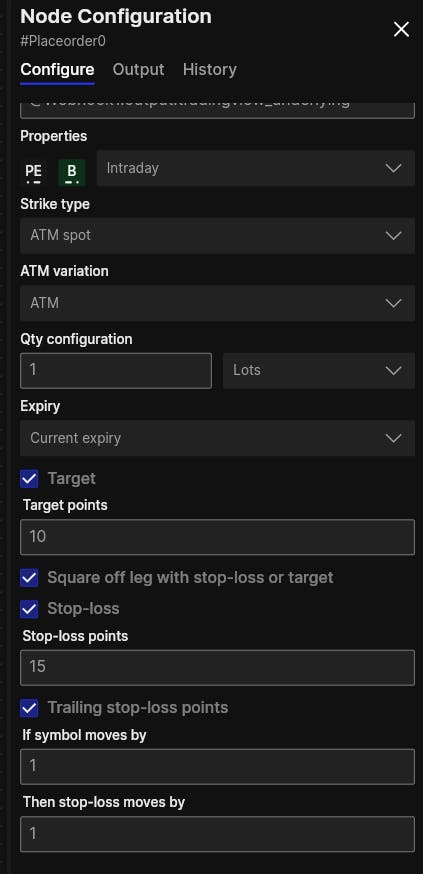
Question 1 (Suitation 1) - How does Trailing Stop Loss work when “Stop-loss points” and “Trailing” values are in %, but applied on the current Stop Loss value (not on entry)?
Example Setup:
-
Entry Price = ₹100
-
Stop-loss points = 15% → Initial SL = ₹85
-
Trailing: If symbol moves by 1%, then stop-loss moves by 1%
-
Target = 10% (₹110)
What actually happens as price rises:
| Price | Move | SL Calculation | New SL |
|-------|------|----------------|--------|
| ₹100 | 0% | ₹100 - 15% | ₹85.00 |
| ₹101 | +1% | ₹85 + 1% of ₹85 | ₹85.85 |
| ₹102 | +2% | ₹85.85 + 1% | ₹86.71 |
| ₹105 | +5% | ₹89.33 + 1% | ₹90.22 |
| ₹110 | +10% | ₹92.95 (final SL) |
Question:
When price reaches ₹110 (target), the Stop Loss is only ₹92.95.
That means only ₹7.95 profit is locked instead of ₹10.
Is this how Fyers FnO automation works when values are in %?
Or should the trailing be calculated on entry price instead of on current SL?
Please clarify the exact logic.
Question 2 (Suitation 2) - Does Fyers support Entry-based Trailing Stop Loss in FnO automation?
Example Expectation:
-
Entry Price = ₹100
-
Initial Stop Loss = 15% = ₹85
-
Trailing rule: If price moves up 1% from entry, then SL also moves up 1% from entry
-
Target = 10% (₹110)
Expected behavior:
| Price | Move | SL (from entry) | New SL |
|-------|------|----------------|--------|
| ₹100 | 0% | Entry - 15% | ₹85.00 |
| ₹101 | +1% | Entry - 14% | ₹86.00 |
| ₹102 | +2% | Entry - 13% | ₹87.00 |
| ₹103 | +3% | Entry - 12% | ₹88.00 |
| ₹105 | +5% | Entry - 10% | ₹90.00 |
| ₹110 | +10% | Entry - 5% | ₹95.00 |
Question:
In this case, at target ₹110, SL is ₹95 → locking ₹10 profit.
Is this possible in Fyers automation? If yes, which setting controls it?
If not, how can we achieve proper trailing that locks most of the profit?
Please respond on priority.
Thanks
Pushpandra Singh