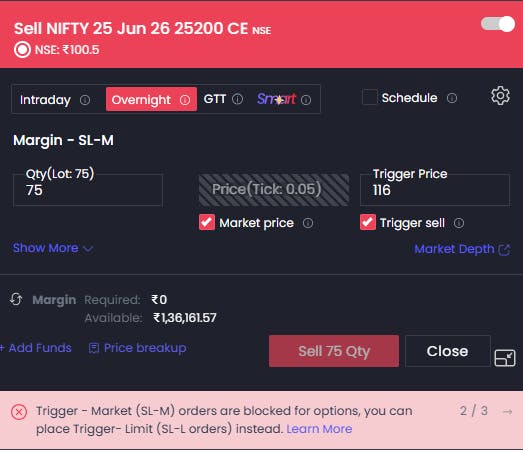
Hi @QMuON3oegb, so you’re trying to sell your Nifty option at ₹115.20 after buying at ₹91.25, and you tried placing it using an SL order. The issue is, since you’re placing a sell-side SL order, the platform expects the trigger price to be below the LTP, because that’s how stop-loss orders work.
But in your case, the LTP was around ₹99.70, and your trigger was set at ₹116—which is above LTP. That’s why it gave you these errors:
Trigger price should be less than LTP
Trigger price should be greater than limit price
This happens because trigger sell orders above LTP aren’t allowed in SL order types.
Since you’re setting a target and not a stop-loss, you can place a regular limit sell order at ₹115.20. Once the market reaches that price, your order will get executed.
Thanks for the clear explanation, Shruthi. Just to confirm: if someone still wants to use a trigger-based approach for a target, would a Sell Stop-Limit order work in any context here, or is it strictly for stop-loss scenarios?
Hey @L5Cz7xj5lH, trigger-based orders like Sell Stop-Limit (SL-L) are specifically meant for stop-loss scenarios and not for setting targets. Since the platform only allows sell-side SL orders when the trigger price is below the LTP, they won’t work for placing profit targets above the current price.
So even if someone tries using an SL-L order as a target, it won’t go through unless the trigger is below LTP—which isn’t helpful for profit booking.
If you’re looking to place both a target and a stop-loss at the same time, using a Bracket Order is a better option. In this case:
Your target can be set as a regular Limit Sell order above LTP
Your stop-loss is placed with a trigger below LTP
This setup allows you to manage both exits from the moment you enter the trade.